
If you're wiped out on a GLP-1, you're not imagining it and you're not doing it wrong. Fatigue is one of the most common things people report, especially in the early weeks. Most of it comes down to one thing — you're suddenly eating far less than your body is used to — with nutrient gaps and blood-sugar swings layered on top. The good news: it usually eases. Here's what's behind it, what deserves a doctor's look, and how to tell whether your energy is actually recovering.
Is GLP-1 fatigue normal?
Common, yes. In Wegovy's weight-management trials about 11% of people reported fatigue, roughly double the placebo group (Healthline). It tends to show up in the first few weeks and again after each dose increase, then settle as your body adjusts.
So a tired stretch early on is expected. What you want to know is whether yours is on the normal downward curve or sticking around longer than it should — which is exactly the kind of thing a daily energy read makes visible instead of leaving to memory.
Why it happens
Fatigue on a GLP-1 usually isn't one cause. It's a few, stacking up.
You're eating much less
This is the big one. Appetite suppression works so well that a lot of people quietly drop to a calorie intake their body can't run on — sometimes under the rough floors (around 1,200 for women, 1,500 for men) below which energy and function start to suffer. Less fuel in, less energy out. If you've lost your appetite almost entirely, undereating is the first thing to suspect.
Nutrient gaps — B12, iron, vitamin D
Eating less, and absorbing differently, means key nutrients can fall short. A study of GLP-1 users found nutritional deficiencies and muscle loss were a real risk, with low B12, iron, and vitamin D among the culprits (ScienceDirect). B12 deficiency in particular is a classic, fixable cause of fatigue, weakness, and brain fog. This is a bloodwork question for your clinician, not a guess.
Muscle loss
Rapid weight loss isn't all fat — some is muscle, and losing muscle saps strength and energy. A case report tied semaglutide-related muscle loss (sarcopenia) directly to fatigue (PMC). Prioritizing protein and keeping up resistance training are the standard defenses.
Blood sugar and hydration
Swings in blood sugar leave you flat, and GLP-1s can nudge you toward dehydration when you're eating and drinking less. Both read as tiredness, sometimes as the brain fog people describe alongside it (GoodRx).
When it's worth a closer look
Most GLP-1 fatigue is the adjustment kind and fades. Some isn't, and it's worth being honest with yourself about which you're dealing with. Check in with your prescriber if the fatigue is severe, keeps getting worse, lasts well past the early adjustment weeks, or comes with dizziness, numbness, a racing heart, or shortness of breath. Bloodwork can catch the deficiencies above. None of this is something to white-knuckle through or diagnose from a blog — including this one.
How to track your energy
The hard part is that fatigue is gradual, and you're inside it. The slow days blur together, so "I've been tired" is about all you can report at the next appointment. A little structure fixes that.
- Rate energy at a fixed time daily. Morning is easiest. A quick 1–5 is plenty; consistency beats precision.
- Watch the trend, not the day. One flat day is noise. A two-week slide, or a steady climb back, is the signal.
- Note what changed. Protein, sleep, a dose step-up. Patterns show up fast when energy sits next to those.
This is the difference between "I think I've felt better lately" and actually seeing the line turn back up — which tells you the protein and the dose adjustment are working, or that something still needs a look.
Where a voice check-in fits
Logging by hand is the thing everyone starts and most quit by week three. HealthOS is built to remove that friction: it reads energy and a few other nervous-system signals from how you sound in a few seconds of normal speech, scored against your own 30-day baseline — your usual, versus today. No wearable, nothing to wear or charge.
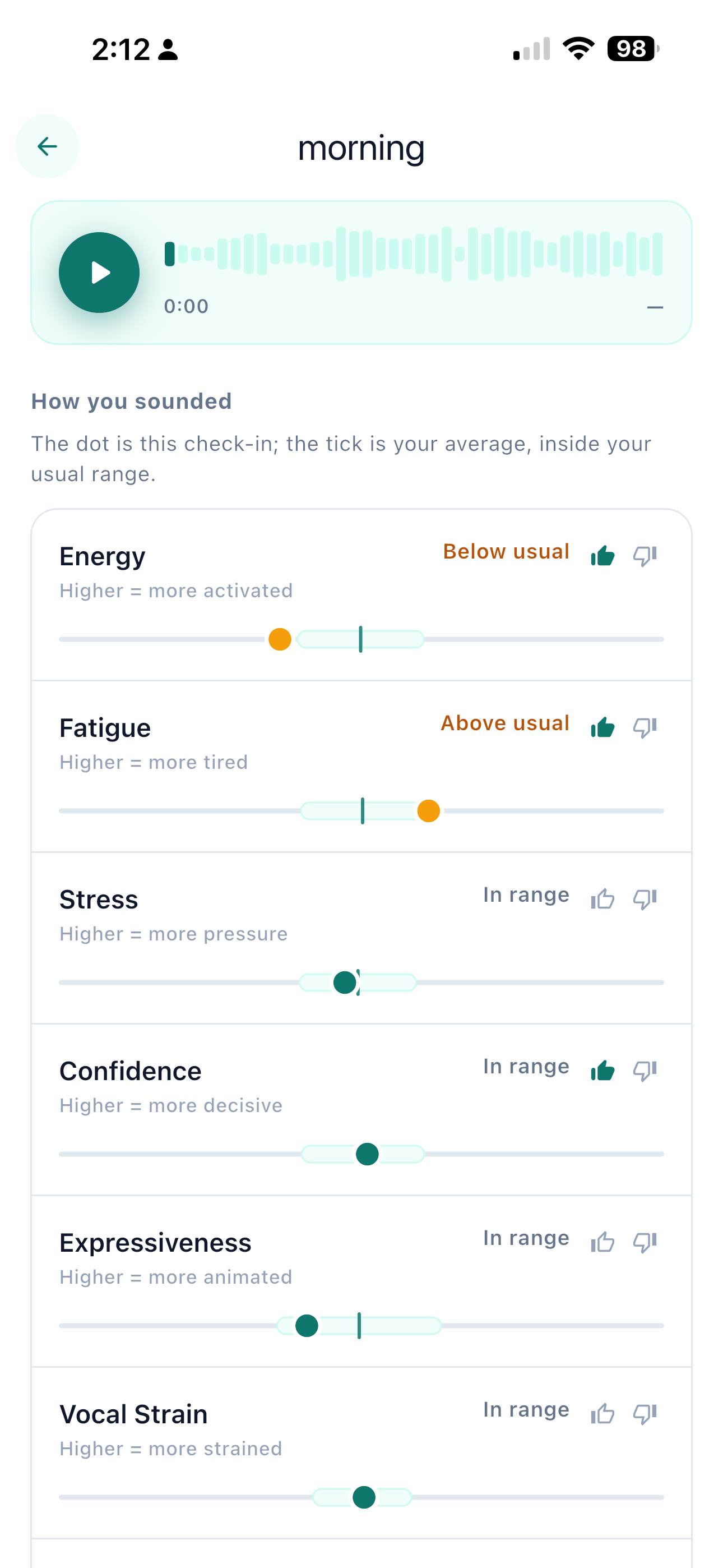
It's a general-wellness tool for self-awareness, not a medical device. It won't diagnose a B12 deficiency or tell you what to do about a side effect — that's your clinician's job. What it gives you is a steady, low-effort read on whether your energy is trending back up, so the recovery you're hoping for is something you can actually see. If you haven't yet, the companion piece on tracking energy and mood beyond the scale covers the bigger picture, and how voice biomarkers work explains the read itself.
The tiredness usually passes. Track it, and you'll know it's passing instead of just hoping.
FAQ
Does GLP-1 cause fatigue? Yes, commonly — especially in the first weeks and after a dose increase. About 11% reported it in Wegovy's trials, roughly double placebo (Healthline). Most of it traces to eating far less than your body is used to, plus nutrient gaps and blood-sugar swings.
How long does GLP-1 fatigue last? For most people it eases within a few weeks as eating stabilizes, and often returns briefly after each dose step-up. Severe, worsening, or lingering fatigue is worth raising with your prescriber.
Why am I so tired even though I'm losing weight? Weight loss and fatigue often run together: very low calorie and protein intake, plus muscle loss and depleted B12, iron, and vitamin D, drain energy even as the scale moves (ScienceDirect).
When should I see a doctor? If fatigue is severe, worsening, or paired with dizziness, numbness, a racing heart, or shortness of breath. Bloodwork can check B12, iron, and vitamin D. Talk to your clinician.
How do I track my energy on a GLP-1? Rate it at the same time daily and watch the trend over weeks. Note what changed. A short log works; so does a voice check-in that scores energy against your own baseline.
HealthOS is a general wellness tool and does not diagnose, treat, or prevent any condition. It is not medical advice. Talk to your clinician about any medication side effects, persistent fatigue, or possible nutrient deficiencies.
Want to see your energy trend instead of guessing at it? Join the HealthOS beta → · Read the FAQ