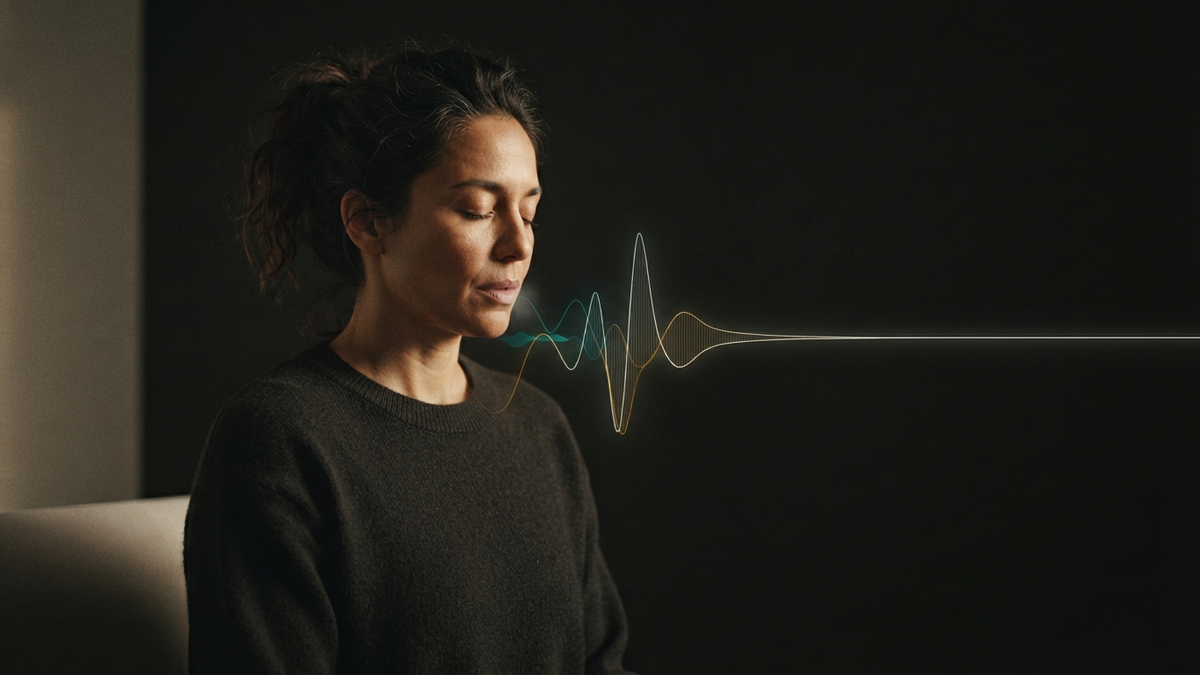
Your whole practice is built on one thing: the state of the client's nervous system. Whether it's regulated or in alarm, whether they can come down, how much load they're carrying before they even walk in. It's the lever everything else moves through. And it's the one thing you've never been able to put a number on. You infer it — from posture, from breath, from how they sound in the first two minutes — and you're usually right. But "usually right, based on a read I can't show anyone" is a hard place to build a practice, prove a protocol, or renew a corporate contract.
The rest of the world is finally catching up to what you've been saying for years. The Global Wellness Summit named nervous-system regulation — vagal tone, felt safety, somatic repair — one of the defining wellness movements of 2026, "the framework the next generation of wellness is building around" (Global Wellness Summit). The demand is here. The measurement isn't.
The state you regulate is real — and the client can't feel it
Nervous-system state isn't a metaphor. Sympathetic activation is a physiological event: the system preparing for and responding to load, as opposed to the parasympathetic rest-and-repair side you're trying to help them reach. That much is settled.
The problem is who can perceive it. The clients who most need regulation — the high-functioning ones running hot for months — are often the least able to feel it, and not because they aren't trying. Chronic stress raises the sensory threshold for internal body signals; interoceptive accuracy drops as stress accumulates (Frontiers in Psychology). The nervous system turns down the very alarm that would tell them to stop.
So when a client says "I'm fine," it isn't evasion — they genuinely can't feel the load they're carrying. A skilled coach reads it anyway: the catch in the voice, the story that doesn't quite line up, the state sitting under the words. That reading is the craft, and no tool replaces it. What's hard isn't your read in the room — it's that the client is often blind to the very thing you specialize in, so the six days between sessions, when you're not there to hear them, stay dark.
Why the tools you've been offered don't fit
The obvious fix is a wearable, and coaches have mostly said no — for good reasons. A wrist sensor reads the body: heart rate, HRV, sleep. It infers stress from physiology and never hears the person. It also asks every client to buy, wear, and charge a device, which doesn't belong in a practice built on talking and breathing. The lab-grade options — EEG, autonomic-monitoring hardware — are more precise and even less portable; they live in a clinic, not in a client's Tuesday.
And self-report — the client's own account — under-reports the load precisely because they can't feel it. Your trained ear fills much of that gap in session; that's exactly the skill. What's still missing is an objective layer that fits how you work: one that reaches past the hour you're together and gives you something you can show, not only sense.
The voice is a direct line to autonomic state
Here's what's been hiding in plain sight. When the sympathetic nervous system activates, it doesn't only change heart rate — it changes the voice. The muscles of breathing and phonation are wired into the same autonomic system you're regulating. Under stress and cognitive load, researchers see autonomic arousal rise and the acoustic properties of the voice shift with it — vocal effort, clarity, and the spectral balance of the sound all move measurably (PMC). The activation you're reading intuitively in the first two minutes of a session has an acoustic fingerprint.
That's the opening. The voice is the one channel that carries nervous-system state and is already the medium your practice runs on. No new hardware, no wrist, no clinic. Just how the client sounds.
What an objective regulation read changes
An objective read isn't meant to sit in your chair — masterful coaching already integrates more signal, in real time, than any device does. It's a second layer beside that judgment, not a substitute for it. Give the client (and you) that layer, and three things shift at once.
You walk in already knowing the week. Not a Monday-morning reconstruction from someone who couldn't feel most of it. You see the actual trajectory of their activation and spend the session on what happened, not on reassembling it.
You can finally prove the protocol. Nervous-system work is notoriously hard to quantify, so it gets sold on anecdote and vibes. A read the client can compare before and after a breathwork series, a vagus-tone practice, or a reset week turns "I think that helped" into a before-and-after you can show. Regulation techniques finally get the feedback loop they've always lacked — did today's practice actually move this client's state, or did it just feel nice?
It opens the conversation with money attached. HR funds what it can measure. Objective pre/post state across a cohort is the ROI story that gets a corporate wellness program renewed instead of cut — the number that lets you compete for a budget you currently can't reach because your outcome lives in a testimonial.
How it works in practice
It's lighter than a dashboard to manage.
The client does a few-second voice check-in on their own phone — their habit, their device — and opts in to share the trend with you. You review the week before the session, and around a protocol you compare the before and after. The only coach-facing piece is "share my trends," not a platform to learn.
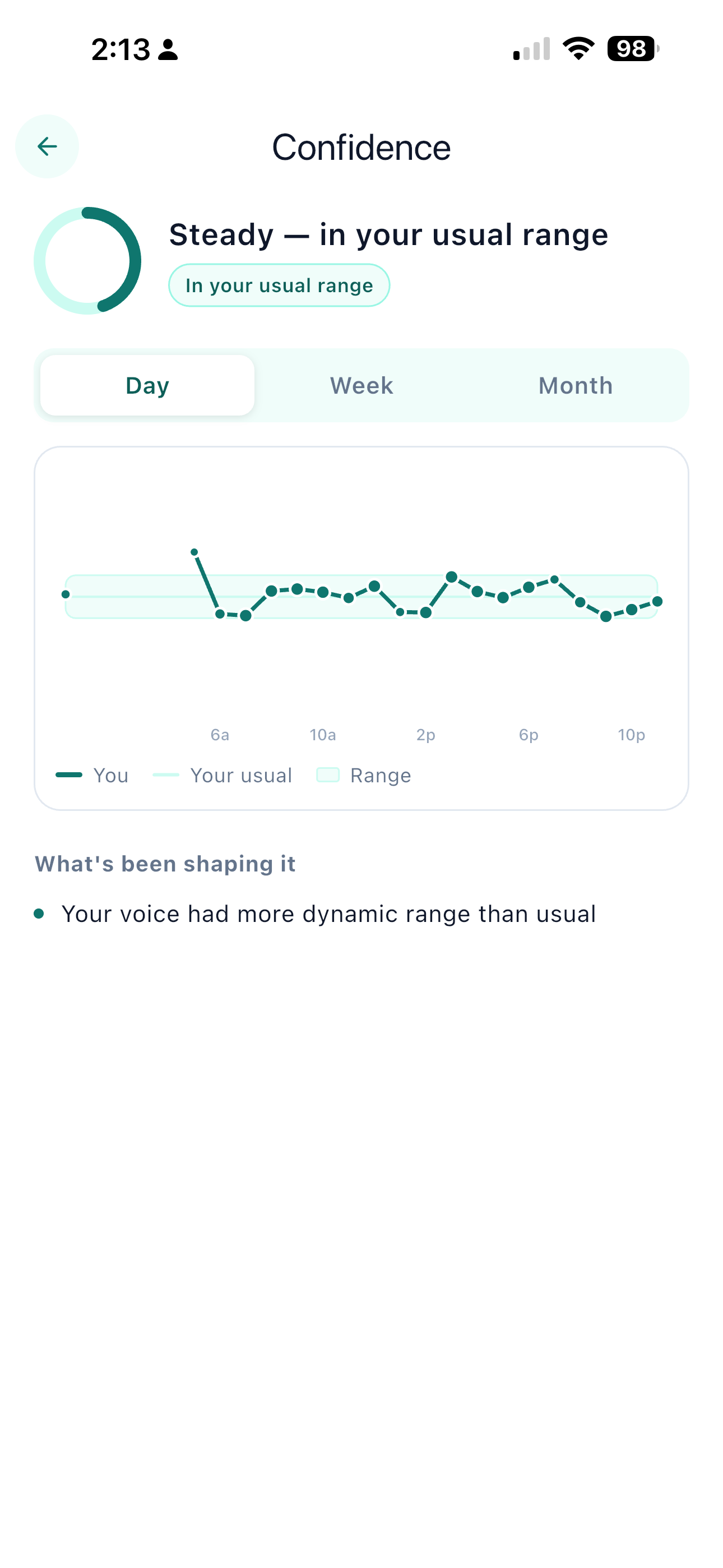
That's the idea behind HealthOS. It reads energy, stress, vocal strain, and other nervous-system signals from how a client sounds in a few seconds of speech, scored against their own baseline — no wearable, no bloodwork, and it runs entirely on-device, so the client's voice never leaves their phone. For higher-status or guarded clients, that privacy is a feature, not a footnote. It reads the arousal side of the state you regulate — the sympathetic load — and it does it in the modality your practice already uses. You can read more on how voice biomarkers work, or how this sits next to a wearable rather than replacing it.
HealthOS is a general-wellness, self-awareness tool, not a clinical or diagnostic device. It doesn't measure a medical construct of "regulation," and it doesn't replace your judgment. It adds an objective layer to the state you already track by ear — reaching into the days between sessions, and turning what you sense into something you can show.
FAQ
Can you really measure nervous-system state from a voice? The autonomic-arousal side of it, yes — sympathetic activation changes the voice in ways speech science has documented for decades (PMC). HealthOS reads those changes against the client's own baseline. It's a relative self-awareness read, not a clinical score.
Why can't the client just tell me? Chronic stress lowers interoception — the ability to feel internal body signals — so the most dysregulated clients are often the least able to report it (Frontiers). The read gives them a signal their body stopped sending.
Why not a wearable or HRV? Those read the body and add hardware that doesn't fit a talking, breath-based practice. Voice needs nothing but the phone already in the client's hand.
How would I actually use it? The client checks in on their own phone and shares the trend; you review before the session and compare before and after a regulation protocol.
Does this replace a coach's read? No — and it shouldn't. Skilled coaches integrate many signals in real time, and even imperfect self-report is workable in their hands. HealthOS is a complementary layer: it extends the read to between sessions and makes a protocol's effect something you can show. It informs your judgment; it doesn't override it.
HealthOS is a general wellness tool for self-awareness. It does not diagnose, treat, or prevent any condition, and it is not a substitute for clinical care or professional judgment.
Curious whether this fits your practice? Join the HealthOS beta → · Read the FAQ