You check the charts before the open. Levels, news, your plan, your risk. The one input most traders never check is the person about to run all of it. And the research is blunt about why that matters: your state isn't a soft side-factor, it's part of your edge. Here's the pre-trade read that catches an off day before it costs you a good setup.
Your state is part of your edge
This isn't motivational-poster stuff. When researchers wired up professional traders during live sessions, even the most seasoned ones showed strong physiological responses — skin conductance, heart-rate shifts — during volatility and trend breaks (Lo & Repin). Emotion is in the chair whether you acknowledge it or not.
What matters is how much it moves you. A study of trader performance found that the people who reacted most intensely to their gains and losses tended to post worse P&L (Management Science). Same strategy, different operator-state, different result. The edge was never just the setup. It's whether today's version of you can execute it cleanly.
The two states that quietly wreck a session
Two states do most of the damage, and both build before you consciously clock them.
Tilt. Emotion overrides the plan: you size up to win back a loss, chase a setup you'd normally skip, abandon your own rules. Most trading "discipline" failures are really tilt wearing a discipline costume. The standard fix is a circuit breaker — a pre-set rule that forces you to step away when you're rattled (Lightspeed).
Decision fatigue. Every read, every click, every "should I?" spends a finite budget. Quality fades, and a lot of traders make their worst calls in the back half of a session — not because the market changed, but because their capacity to respond to it did. You go on autopilot exactly when the day demands sharpness.
Why "just be disciplined" doesn't work
Here's the catch with willpower: you can't apply a rule you can't feel coming. By the time you've placed the revenge trade, the state that caused it has already won. The off-state comes first; the bad decision is downstream. So the leverage isn't gritting harder mid-tilt — it's noticing the state early, ideally before the bell, while you can still decide to size down or stand aside.
That's a measurement problem, not a motivation problem.
The pre-trade check
Good traders already run a pre-market routine — plan, levels, risk. The missing step is pointing that same discipline at yourself. Before you take a position, ask the honest version of one question: am I rested, calm, and clear today, or am I fatigued, rattled, or forcing it?
If you're off, the answer isn't to push harder. It's to cut size, tighten rules, or sit the session out. None of that costs you anything; pushing through an off day does. The check is small, it's free, and it's the whole intervention.
A 5-second read before the open
The trouble with self-assessment is that it drifts — "I'm fine" is what you tell yourself right up until you're not. HealthOS is built to make that read objective and fast: it picks up stress, energy, and a few other nervous-system signals from how you sound in a few seconds of speech, scored against your own baseline. Your normal, versus today.
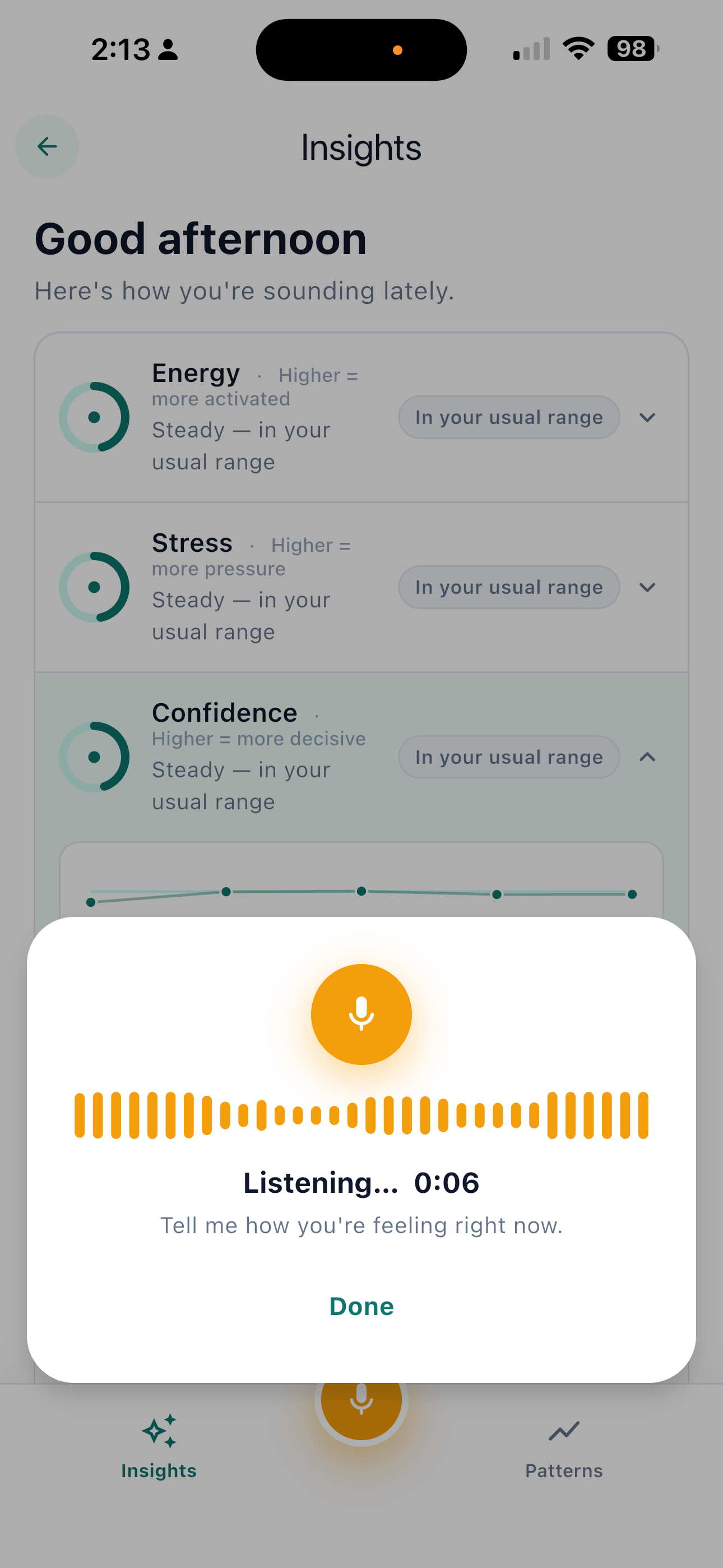
It runs entirely on-device, so it's a check you can do at your desk before the bell without anything leaving your phone. To be clear about what it is: a general-wellness, self-awareness tool, not financial advice and not a market signal. It won't tell you what to trade or predict anything — it just gives you an honest read on the operator, so the call about whether today's you should be sizing up, sizing down, or stepping back is yours to make with better information. If you want the mechanics, how voice biomarkers work covers the read itself.
You'd never trade a setup you hadn't checked. The person trading it deserves the same look.
FAQ
Does emotional state really affect trading performance? Yes. Live-trader studies show strong physiological reactions even in pros (Lo & Repin), and more emotionally reactive traders tend to post worse P&L (Management Science).
What is trading tilt? When emotion overrides your plan — revenge trades, oversizing, chasing. It builds before you notice, so a pre-emptive check beats in-the-moment willpower.
How do I know if I'm fit to trade today? Pair your market prep with a quick self-check: rested and clear, or fatigued and rattled? If you're off, size down or sit out.
What's a pre-trade routine? A consistent pre-session sequence — plan, levels, risk, and a read on your own state — so the decision to trade is made before the pressure hits.
HealthOS is a general wellness tool for self-awareness. It is not financial advice, not a trading signal, and does not predict markets. It does not diagnose, treat, or prevent any condition.
Want an honest read before the open? Join the HealthOS beta → · Read the FAQ