On a GLP-1, the scale is the number you watch and the worst one for telling you how the month actually went. The changes that matter most, like steadier energy, fewer afternoon crashes, a quieter relationship with food, a mood that's either lifting or going flat, never show up on the bathroom floor. This is what to track instead, and why those signals are so easy to miss in yourself.
The scale is a lagging, noisy number
Weight is the metric every GLP-1 program leads with, and it's the one most likely to lie to you on a given Tuesday. Water, hormones, sodium, and a single big meal can swing it two or three pounds overnight, none of which is fat.
Then there's the plateau. As you lose weight, your resting metabolism falls. You're a smaller body that needs fewer calories, so the same routine that dropped five pounds a month ago drops nothing this month (Spruce). The scale flattens. People read that flat line as failure, second-guess the medication, and miss the fact that plenty is still changing, just not the number they're staring at.
If weight is the only thing you measure, a normal stall feels like the whole thing stopped working. It didn't.
What actually shifts, and the scale can't see
Three things move on a GLP-1 that have nothing to do with the readout.
Energy
Fatigue is one of the most common complaints in the early weeks. In Wegovy's weight-management trials, about 11% of people reported it, roughly double the placebo group (Healthline). Some of that is the drug. A lot of it is simpler: appetite suppression works so well that people quietly drop to a calorie intake their body can't run on, and the tank empties. A few describe it as brain fog more than tiredness, with slower thinking and harder focus (GoodRx).
Here's the part worth tracking: energy often turns the corner. Once intake stabilizes and sleep settles, the same people frequently report steadier energy than before, the kind that doesn't crater at 3 p.m. That arc, from drained to steady, is one of the clearest wins on the whole journey, and the scale shows none of it.
Mood and motivation
This one needs care, because it cuts both ways. Some research points to mood and quality-of-life improvements as weight comes down and blood sugar steadies (PMC review). But a smaller group reports the opposite: a flatter, less-driven feeling, sometimes called the "missing spark," where food stops being interesting and so, oddly, do a few other things (GLP-1 Newsroom).
The likely reason is mechanical. These drugs act on the brain's reward and motivation circuits, not just the stomach. The science is still early and the effect is individual. The practical takeaway is the same in both directions: your mood is moving, up or down, and it's worth knowing which way before a month goes by.
Food noise
The constant background chatter about food, what's next, what's in the fridge, goes quiet for a lot of people. That's a relief, and it's also a real change in your day that no weight measurement records. Worth a line in whatever you track.
Why these shifts are so easy to miss
You'd think you'd notice your own energy and mood. The problem is that the change is gradual, and you're inside it.
When something drifts a little each day, there's no single morning you wake up and feel the difference. The new normal just quietly replaces the old one. People often only catch a GLP-1 mood change when they skip a dose and something snaps back, or when a partner says you've seemed flat lately before they'd have said it themselves. Self-report on its own is unreliable for exactly this reason: "I'm fine" is what you say when the slide has been slow enough to feel like nothing.
That's the gap. The signals that matter most on a GLP-1 are the ones you're worst positioned to see in yourself.
How to actually track it
You don't need a spreadsheet or nine new metrics. You need two or three signals, measured the same way each day, looked at over weeks.
- Pick what matters to you. Energy and mood are the high-value pair for most people. Add food noise or sleep if they're part of your story.
- Rate at a fixed time. The same moment each day; morning is easiest. Consistency beats precision, so a quick 1–5 is plenty.
- Read the trend, not the day. One rough day means nothing. A two-week slide means something. The line is the point.
- Pair it with the scale, don't replace it. When weight stalls but energy is climbing, you can see the month was a win. That's the read that keeps people on a protocol that's actually working (Form Health).
A daily note does this. So does a tape measure and a monthly photo for the physical side. The friction is the catch: manual tracking is the thing everyone starts and most people quit by week three.
Where a voice check-in fits
This is the problem HealthOS was built for. Instead of asking you to rate yourself, which is the self-report that drifts, it reads energy, stress, and a handful of other nervous-system signals from how you sound during a few seconds of normal speech, then scores them against your own 30-day baseline. Not a population average. Your usual, versus today.
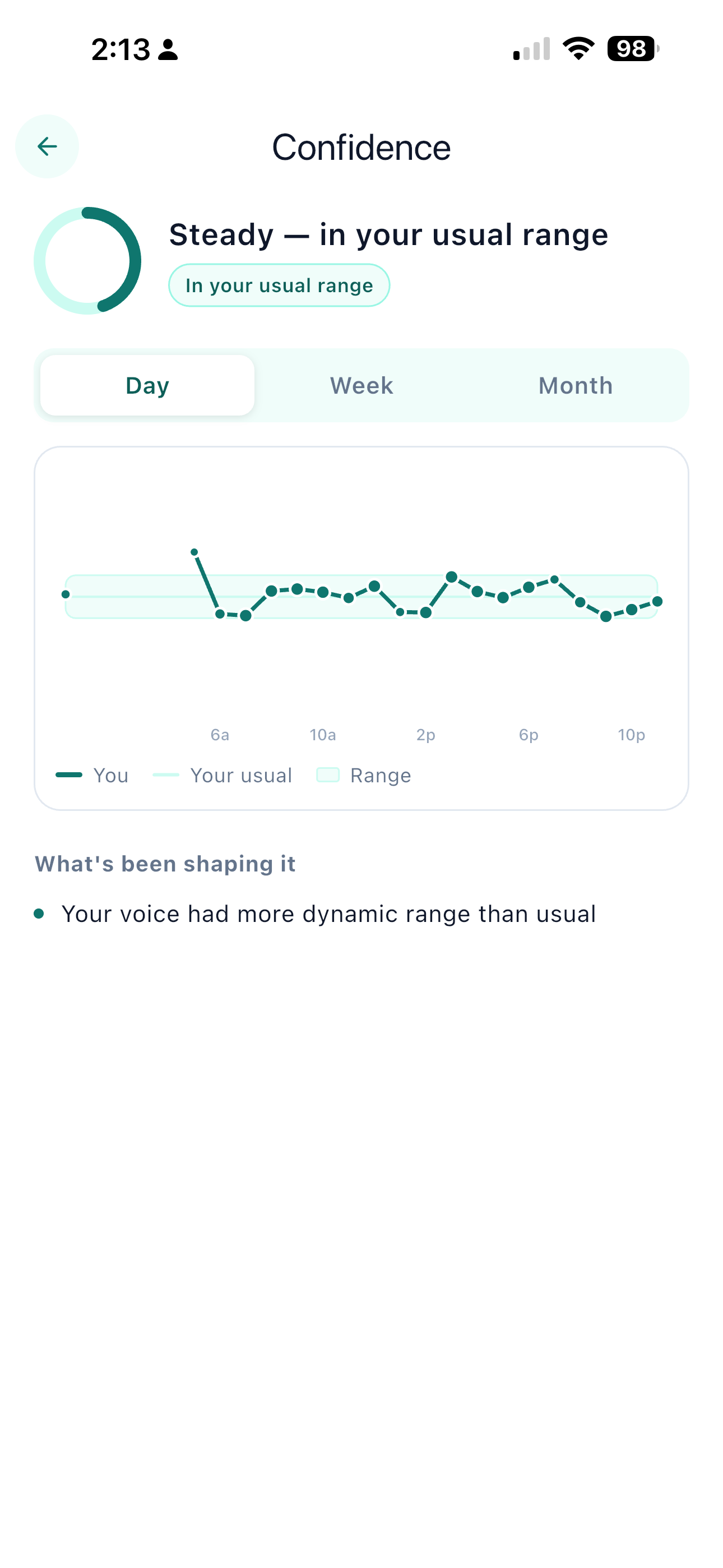
It's a general-wellness tool for self-awareness, not a medical device. It doesn't diagnose anything or tell you what to do about a side effect; that's a conversation for your prescriber. What it gives you is the thing the scale can't and a journal usually won't: a steady, low-effort read on the parts of a GLP-1 month that are otherwise invisible until they've already added up. It runs entirely on your phone, and your voice never leaves the device. No wearable, no extra hardware. You can read more on how voice biomarkers work and how this compares to a ring or watch.
The scale will do its slow, noisy thing. Track the rest, and you'll actually know how the month went.
FAQ
Does a GLP-1 cause fatigue? It can. In Wegovy's weight-management trials, about 11% of people reported fatigue, roughly double the placebo rate (Healthline). Some of it is the medication; a lot of it is eating far less than your body is used to.
Why does the scale stall on a GLP-1 even when I'm doing everything right? As you lose weight, your resting metabolism drops, which is a normal adaptation (Spruce). The scale slows or flattens for weeks while energy, mood, and body composition keep changing underneath it.
Can a GLP-1 change your mood? Some people report it. These drugs act on the brain's reward and motivation pathways, not just the gut, so a few users describe a flatter, less-driven feeling alongside the appetite change. Research here is early. If your mood drops in a way that worries you, talk to your prescriber.
What are non-scale victories on a GLP-1? Changes the scale can't show: steadier energy, fewer crashes, quieter food noise, better sleep, looser clothes, a calmer baseline. For many people these arrive before, or instead of, a big weight drop.
How do I track energy and mood on a GLP-1? Pick two or three signals that matter to you, rate them at the same time each day, and look at the trend over weeks rather than days. A short daily note works. So does a voice check-in that scores energy and mood for you against your own baseline.
HealthOS is a general wellness tool and does not diagnose, treat, or prevent any condition. It is not medical advice. Talk to your clinician about any medication side effects or mood changes that concern you.
Curious what your own baseline looks like? Join the HealthOS beta → · Read the FAQ