The recovery score was supposed to help. Instead, for a lot of people, it's the first thing they brace for in the morning — open the app, see a red number, and feel the day get worse before it's started. The tool meant to lower stress has quietly become a source of it. There's a name for the sleep version of this, it shows up in the research, and there's a way to keep the signal without the dread.
When the score becomes the stressor
The sleep-tracking version has a clinical name: orthosomnia, coined in a 2017 paper to describe an unhealthy preoccupation with hitting "perfect" sleep numbers. The cruel twist is that the worry about the data tends to make sleep worse — people identified with orthosomnia consistently score higher on insomnia measures (PMC).
It's not just sleep. The same pattern shows up across recovery, readiness, and heart-rate scores: checking compulsively, feeling uneasy when the number isn't where you want it, reading a small dip as a warning sign. Clinicians have started calling it wearable-induced health anxiety (Banner Health). You stopped trying to rest and started trying to beat a high score.
It's more common than you'd think
Orthosomnia isn't a fringe case. In a general-population sample, prevalence ran anywhere from roughly 3% to 14% depending on how strictly it was defined (PMC) — and younger, data-driven adults, exactly the people most likely to own an Oura or WHOOP, are the most susceptible. If you've ever had a good morning ruined by a bad score, you're in a large club.
Why a score is the wrong shape for this
A single 0–100 number invites you to treat your body like a test you can pass or fail. That framing is the problem, for two reasons.
First, the number and how you feel often disagree. A wrist or ring sensor measures physiology and infers a state from it. It can't see your actual mental and nervous-system state, so it hands you a confident green "recovered" on a day you feel hollow, or a red score on a morning you feel great. When the data contradicts your own experience, you're left anxious and unsure which to trust.
Second, the numbers themselves are imperfect. Consumer trackers can overstate how often you woke up and misjudge your sleep stages, so some of the score you're agonizing over is noise. A precise-looking number isn't the same as an accurate one.
What actually helps
The research and the clinicians converge on the same advice, and none of it means throwing out your ring (GoodTherapy):
- Read trends, not single days. One red morning is noise. A two-week direction is signal. The daily number is the part that drives the anxiety and carries the least information.
- Check yourself before you check the app. Ask how you actually feel first. Then look at the data as a second opinion, not the verdict.
- Take breaks. Periodic time off the tracker is a feature, not a failure.
- Prefer a relative read over an absolute grade. "Higher or lower than your own usual" is far less anxiety-inducing than a score that begs to be maxed out.
A read, not a grade
This last point is the whole idea behind HealthOS. It doesn't hand you a number to beat. It reads energy, stress, and a handful of other nervous-system signals from how you sound in a few seconds of speech, and shows each one relative to your own baseline — in your usual range, a little below, a little above. Not a leaderboard. Your normal, and where today sits against it.
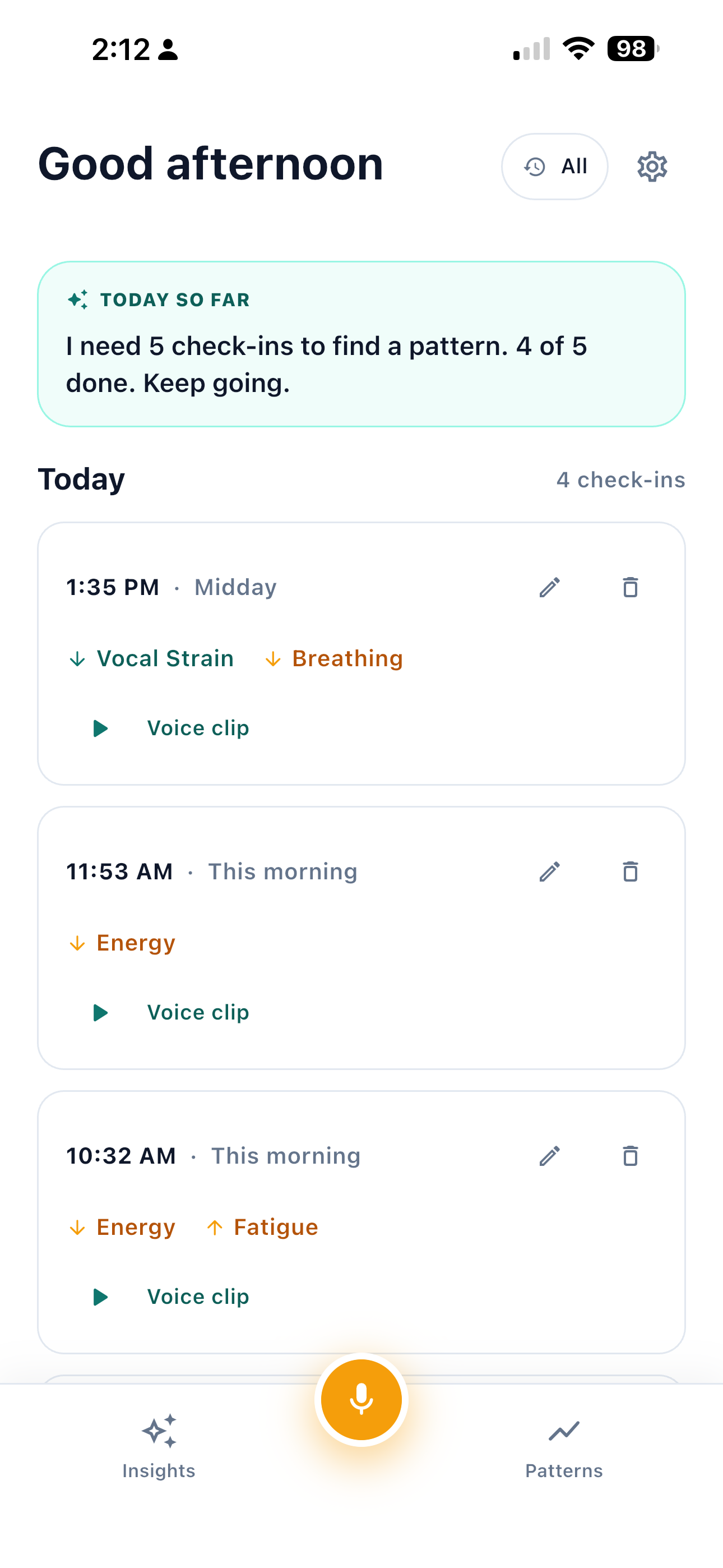
Because it reads the mind layer rather than re-scoring your heart rate, it works alongside the wearable instead of giving you one more number to dread. Keep your ring for what it's good at; you can read how voice compares to a wearable and how the read itself works if you want the detail. It runs entirely on-device, and your voice never leaves the phone.
HealthOS is a general wellness tool, not a treatment for anxiety. If checking your data has started to affect your sleep, your mood, or your relationships, that's worth raising with a professional — and worth taking seriously, not scoring.
The point of tracking was to feel more in control, not less. A signal you can read calmly beats a grade you brace for.
FAQ
What is orthosomnia? An unhealthy preoccupation with achieving "perfect" sleep driven by tracker data. It was named in a 2017 paper, and it's linked to higher insomnia scores — worrying about the numbers can make sleep worse (PMC).
Can a wearable cause anxiety? For some people, yes — compulsive checking and unease when numbers aren't "perfect" is a recognized pattern (Banner Health). If it's affecting your sleep, mood, or relationships, talk to a professional.
Why doesn't my readiness score match how I feel? The score measures your body and infers a state; it can't read your actual mental and nervous-system state. That gap is why a "recovered" score can land on a day you feel wrecked.
How do I stop obsessing over the scores? Read weekly trends, check how you feel before opening the app, take breaks, and favor a read that's relative to your own baseline over an absolute score to beat.
HealthOS is a general wellness tool and does not diagnose, treat, or prevent any condition. It is not medical advice. If anxiety about health data is affecting your daily life, consider speaking with a qualified professional.
Want a read you can check calmly? Join the HealthOS beta → · Read the FAQ